Let’s be honest: most of us don’t read poetry for fun. Depending on the piece, poetry can be complicated, wordy, and hard to digest. For me, I find that reading poetry demands the reader to pick apart the stanzas and analyze what the Poet is really trying to say, and that doesn’t sound like a leisurely activity. Also, some poetry can be so vague that almost the entire story is left to be interpreted by the reader. I do, sometimes, find it interesting to interpret ambiguous poetry, especially when the poet intended for readers to draw varied conclusions. Now, what really captured my attention with the poem I chose for this blog is how none of that stuff I just mentioned describes this piece AT ALL.
Starting with the poet himself: Kevin Coval, an American-Jew from the Chicago suburbs with a passion for rap music and bringing together his community in Chicago. Coval is dedicated to giving back to his community by bringing people together through the expression of each person's individuality. He started a program in Chicago which is like an open mic night, where young people come together and share their poems. Coval crafted a collection of poetry called “Everything Must Go,” and in it, he included this poem that can also be described as a graphic novel? A picture will explain it better than I can.
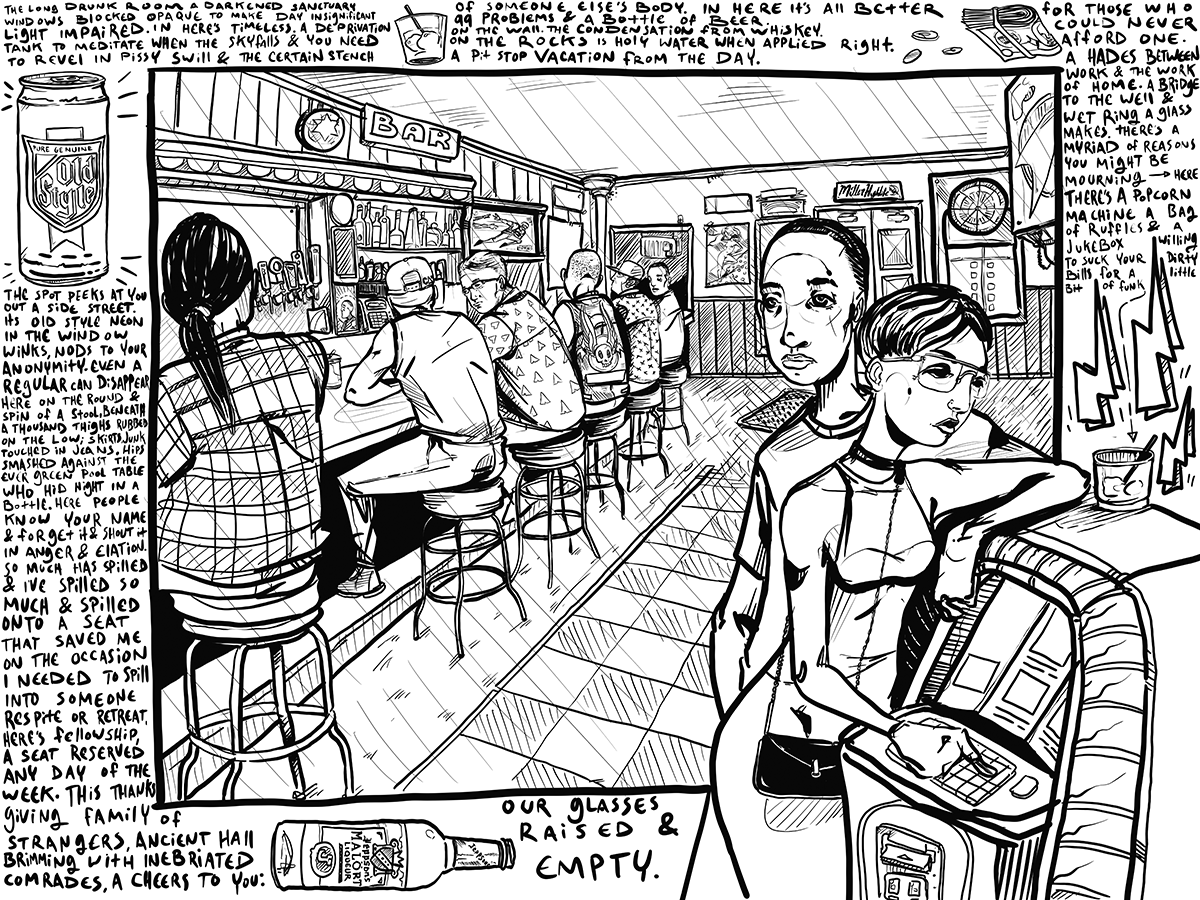
Anyways, this poem Coval wrote is about a bar, presumably in Chicago. What I love about this piece, though, is the accompanying art, and this may sound elementary, but it makes reading this piece enjoyable by bringing together the whole poem. Coval describes the locale as a “room, a darkened sanctuary,” which could mean many things. Without the included graphic, I might assume he is referring to a dank basement or something of that sort. This well-designed drawing and additional sketches help me understand what Coval is trying to say about this particular bar: that it’s more than a bar. It’s representative of an oasis in a desert, and as Coval describes, this bar is “a pit stop vacation from the day.” He describes the objects in the room - the drinks, the jukebox, the bar stools - in such a way that he endows each of them with a lively energy that reflects the energy Coval sees in his city. With support from his graphic, Coval shows how this bar is a place of communion between the bartender, the patrons, and even the inanimate objects present. While Coval is very skilled with his use of language, the images included really tie this whole piece together so well. The poem is definitely worth a read.


That's so cool that he started a sort of open mic night for people to share their poetry and thoughts! This poem seems really cool, maybe as a metaphor that everyone has their own oasis--a place to be relaxed.
ReplyDeleteI think it's so cool how he brought together illustration and poetry like that! I don't typically think of comics or graphic novels as canvases for poetry, but I like how it works. Especially since poetry is so full of different meanings and can be hard to visualize sometimes.
ReplyDeleteI love art and poetry... especially combined. It creates a much deeper message with a visual!
ReplyDelete